
by Carl Lipscombe | Sep 6, 2014 | stories
Grandparents Day is especially meaningful for me because I was raised by my grandmother, Ellen “Olive” King, until I was age 13. My grandmother was born in 1912 in the South Bronx, part of the first generation of African Americans born in NYC after the Great Migration from the South after Reconstruction. “Ollie” or “Mrs. King” (as the neighbors called her) was wildly popular. My most vivid memories of my grandmother consist of accompanying her on various errands during the day, stopping almost every hour to talk to one of her many friends in the neighborhood. Throughout her life she worked as a seamstress, a housekeeper, and ran a laundromat for over 20 years. She even had a small part (along with her siblings) in a silent movie. Reflecting on her life and work, the most important lesson that I learned is the interrelatedness of work and community. You see, my grandmother’s work, in the laundromat and as a domestic worker, was how she participated in the community. Before the internet and the 24 hour news cycle, discussions about current events, politics, music, art, etc., took place in the laundromat, or the corner store, or anywhere else where neighbors could gather. While today, the “gathering place” may be different, like my grandmother, I strive to have my community inform my...
by Candace Johnson | Sep 6, 2014 | stories
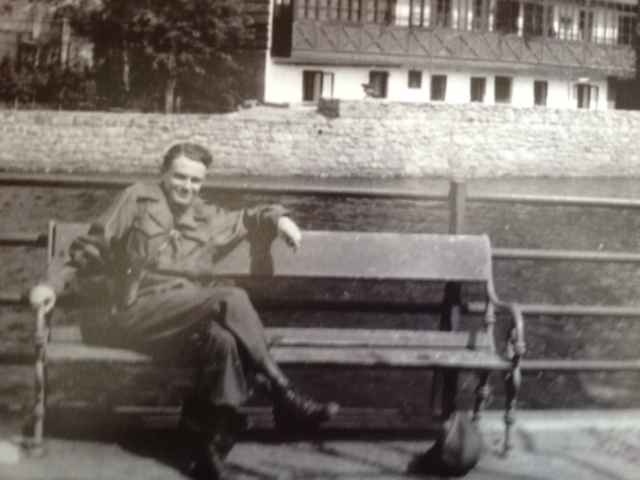
My grandfather, Bill Flynn, worked as a lawyer and committed his life to public service and combating corporate war profitteering. As the son of a railroad worker in Michigan, he was the only one of his siblings to go to college and later pursue a degree in law. After his first year of law school, Bill Flynn was drafted into the army and was deployed to the frontlines of the infantry two days after D-Day, the Allied invasion of Germany-occupied France. My grandfather’s service in the infantry of World War II was a defining experience of his life and one that determined the future path of his career in law. He witnessed the frontlines of ground warfare, experienced the heart wrenching loss of his fellow armymen, and–upon the 1945 defeat of Germany–traversed through Germany to Czechoslavakia to liberate the concentration camp of Flosenburg. Upon returning to the United States, he returned to law school at University of Wisconsin to find that nearly 2/3rds of his fellow law students had been killed on the frontlines of the war. My grandfather was an understated man–he rarely talked about the realities of warfare or his experience of loss. But I know that this experience defined his sense of purpose and solidified his commitment to the values of democracy, human life, and opposing facism and tyranny. As a lawyer, my grandfather devoted his life to public service and passed over opportunities in the high paid corporate sector to work for the US government. He served as the chairman of the Western Renegotiation Board, a government agency charged with reviewing private defense contracts with...

by Candace Johnson | Sep 6, 2014 | stories
Just this year, my grandmama Gloria Cooper passed away. Only a few years before her death, she was diagnosed with alzheimer’s and from there her health quickly deteriorated. But really, we knew something was wrong much earlier. You see, my grandma was all heart. She called all of her grandchildren, “grandmama’s babies”, and we were her babies. During the day when my parents and my cousin’s parents went to work, all of the kids went to stay with grandmama. She stayed at home, while my grandpa worked constructing elevators. Taking care of a bunch of kids of varying ages and temperaments is real work, but it wasn’t always considered work. Grandmama made us breakfast, lunch, and dinner, cleaned up after us, told us stories, broke up our fights. She did everything; she worked hard. I won’t go into the details of how her illness in her later years changed her, but those who have family members impacted by alzheimer’s know how much it hurts to see them slowly lose themselves. My grandmama was much more than a grandmama, but she frequently said being with us made her happiest. My grandmama loved to care and she was good at it. While her care for us never left, she couldn’t do the things that she used to. For her that was the hardest thing. From my grandmama, I learned that taking care of family deserves just as much respect as being employed. Her grandchildren are a living testament to her legacy. When I have children and grandchildren, I hope to be just like her; a pillar in her family, a matriarch,...

by Joe Thomas | Sep 6, 2014 | stories
My grandfather, Hal Thomas, came back from World War II and moved to St. Louis where he went to school on the GI Bill and worked the assembly line at McDonnell Douglas for thirty years. As a member of the International Association of Machinists, he had decent pay, seniority to choose his work schedule, and a good pension. He sent five children to college on his union paycheck, and enjoyed a decent retirement. When I was a child, he was already retired and hosted the entire extended family for dinner every Sunday at the house he bought with his union job. As a labor and community organizer, what Hal Thomas was able to provide for his family is what I work for all workers to be able to provide for their...

by Scarlett Ahmed | Sep 5, 2014 | stories
My grandmother worked a variety of secretarial jobs at Saint Bonaventure University near my hometown in western New York. A friend told her to take civil service exams for jobs with the campus post office. She did and ended up working as a postal clerk for many years. During that time, she trained a succession of postmasters who were all, by university tradition, Franciscan friars. My mother, a women’s libber, eventually encouraged my grandmother to protest this. She did and was appointed the first woman, first lay-person postmaster at the university. I guess it caused quite a scandal at the time. The family always joked that the appointment letter was signed by President Richard Nixon (we weren’t big fans). In my own work life, I try to balance my grandmother’s work ethic with my mother’s rebelliousness. They are both my...
by Roger Beau | Sep 5, 2014 | stories
I’m 3/4 Swiss. During the 1840s there was massive unemployment in Switzerland due to the invention of the automated Jacquard Loom in France. Cloth making was cottage industry with cloth being made on hand looms. the Swiss government created 2 immigration societies, one was sent to South America the other to the US. They were put on a boat traveling the Rhine to the port in the Hague where they boarded a ship which took 7 weeks to cross the ocean. Landed at Philadelphia, walking to Pittsburg where they boarded a boat sailing the Ohio river West. During the journey the chose 2 men which they tasked to find suitable land for the group. The two set out from Indiana while the main group continued on to the Mississippi and St Louis. Strief and Durst walked across Indiana and Illinois not seeing anything they felt suitable. Talking to locals they heard there was land in Wisconsin. They set out for Wisconsin. At Mineral Point they were told there was land to the East of there 30 miles or more. Going there they found what reminded them of home: pine trees, hills and rocks. They went back to Mineral Point which had the land office for the area and purchased the land. Sending word back to the group in St Louis they met at Galena walking together to their new home which they called New Glarus. With winter coming on they set about building shelter for everyone then divided up the land purchased according to what each put into the fund. Not having skills for farming they contacted the county...
